MMOexp:Resolve Stacking Has Created Diablo IV’s Tankiest Barbarian Ever
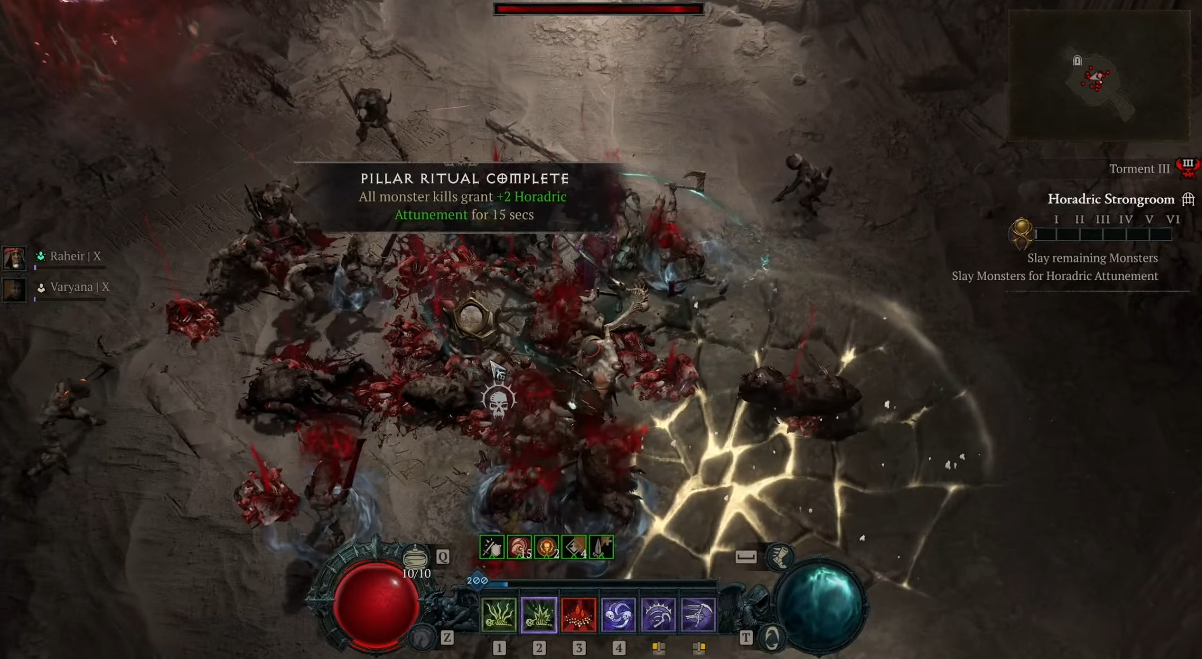
The endgame landscape of Diablo 4 Items is shifting again, and this time it isn’t just a simple balance tweak or seasonal adjustment—it’s a full-blown systems interaction explosion. Recent high-level testing from advanced Barbarian setups reveals a build ecosystem that is simultaneously more tanky, more explosive, and more bug-interactive than ever before. From face-tanking Pit 135 bosses without Melted Heart of Selig, to reaching near-immortal levels of damage reduction through resolve stacking, the current meta is sitting at a fascinating intersection of power and instability.
At the center of it all is a “Bro” style Barbarian summon build that has evolved far beyond its original design. What was once a straightforward Call of the Ancients archetype is now a multi-layered engine of cooldown abuse, defensive stacking, and unintended synergy—capable of pushing Pit 150 while casually deleting bosses or, in some cases, breaking the game entirely.
A Build That Tanks Without Melted Heart of Selig
One of the most striking discoveries from recent testing is just how durable modern Barbarian setups have become without relying on traditional “mandatory” defensive uniques like Melted Heart of Selig.
Instead of depending on item-based damage absorption mechanics, the current build achieves near-immortality through layered mitigation systems. In practice, this means a character can stand in a high-tier Pit (135 and beyond), absorb hits from elite enemies like the Butcher, and simply refuse to die.
The implication here is massive: survivability is no longer tied to a single keystone item. Instead, it is distributed across temporary buffs, passive stacking mechanics, and gear tempering strategies that multiply damage reduction to absurd levels.
Even in an unoptimized state—with gear pulled directly from stash and minimal refinement—the build still demonstrates Pit 135 clears while maintaining face-tank behavior. This suggests the ceiling is not just high; it is likely significantly higher than what current leaderboard pushes are already achieving.
Resolve Stacking: The Hidden Defensive Breakpoint
The most important defensive innovation in this setup comes from a mechanic that revolves around stacking “Resolve” far beyond intended limits.
Through interactions between gear affixes, tempering changes, and scaling mechanics (notably interactions involving Glenn’s Anvil), players have discovered a way to push Resolve stacks up to extreme values—reportedly up to 41 stacks or more in live testing conditions.
Each stack provides approximately 4% damage reduction, which creates exponential survivability scaling when fully combined. In extreme cases, coordinated testing between players has reached theoretical damage reduction values approaching 99.4%.
At that point, the build stops behaving like a traditional character and starts behaving like a mitigation engine. Incoming damage becomes functionally irrelevant unless it bypasses or ignores reduction layers entirely.
However, this power does not come for free. The tradeoff is clear: offensive stat allocation becomes more constrained. Players must choose between:
Critical strike chance
Maximum Resolve stacking
Hybrid survivability and damage setups
Interestingly, this creates a new meta tension where players are actively deciding how close they want to be to “unkillable” versus “maximum DPS output.”
40–50 Trillion Damage While Unoptimized
Despite its defensive dominance, the build does not sacrifice offense entirely. In fact, reported damage output reaches 40–50 trillion in real gameplay conditions—even without full optimization, masterworking, or perfect gear transfigurations.
This is a critical point: the numbers being achieved are not theoretical peak values. They are functional outputs from a build that is still incomplete.
Once properly optimized, the expectation is that damage ceilings will continue to rise significantly, especially when paired with full gear refinement and ideal stat distribution.
In other words, the build is simultaneously:
Nearly unkillable
Massively damaging
Not yet fully optimized
That combination is what makes it particularly dangerous in the current meta.
Bug Interactions: Highlander and Ancient Multiplication Chaos
A major part of this build’s identity comes from unintended interactions involving the Highlander node and Call of the Ancients mechanics.
The Ancient Duplication Glitch
One of the most chaotic discoveries involves zoning mechanics combined with Highlander usage. When executed correctly, players can:
Summon an Ancient
Zone out of an area
Return with the Ancient still following
Recast Highlander
Multiply summons
This creates a cascading effect where Ancients duplicate repeatedly until the screen fills with dozens—or even over a hundred—summoned entities.
In extreme testing conditions, players have reported:
~100 Ancients active simultaneously
Severe performance lag
Attack desynchronization
Server instability concerns
At this scale, combat becomes almost irrelevant. The game engine struggles to process entity behavior, leading to situations where enemies stop reacting entirely or damage output becomes inconsistent.
Eventually, once combat resumes properly, each Ancient may deal in the range of 15–16 billion damage per hit—but even that is not enough to significantly move high-tier enemy health pools at Pit 140+ levels.
The result is a visually impressive but mechanically unstable gimmick that is likely unintended and expected to be patched.
Cooldown Abuse and Infinite Shout Cycles
Another major component of the build revolves around cooldown manipulation. Previously, certain interactions allowed near-permanent uptime on Call of the Ancients through systems like Marshall and shout resets.
While some of these mechanics have been adjusted or partially fixed, remnants still exist that allow for:
Rapid ultimate cycling
Continuous shout uptime
High mobility looping
In its strongest form, the build enables near-permanent movement speed boosts (reportedly up to 200%), effectively turning the Barbarian into a constant high-speed summoning engine.
Even though some of these interactions may be unintended or partially fixed, enough remain to keep the archetype extremely powerful in speed content and Pit pushing alike.
Wrath of the Berserker Fixes and Duration Scaling
One of the more stable changes in the current environment involves Wrath of the Berserker mechanics. Previously, certain setups allowed problematic interactions with uptime stacking. Now, duration scaling behaves more predictably:
Maximum combined uptime: ~35 seconds
Base cooldown: ~68 seconds
While permanent uptime is no longer possible, players can still extend the buff significantly using cooldown reduction and duration modifiers.
This creates a more balanced—but still powerful—rotation system where players must choose timing windows instead of maintaining constant uptime.
Importantly, this does not cripple the build. Instead, it forces more deliberate sequencing of damage phases.
The Leap Variant Evolution: Faster, More Summons, More Flow
One of the most interesting developments is how the Leap-based variant of the build has evolved in response to changes.
Instead of relying on Highlander abuse, the Leap variant now focuses on:
Increased attack speed scaling
Faster leap animations
Improved summon generation
Alternative unique setups (such as swapping defensive or offensive gear pieces depending on content)
A key substitution involves replacing Crown of Lucion with Ariadot’s Bearings in some setups, trading raw damage for additional summons and higher density presence.
This variant emphasizes mobility and pacing. The Barbarian effectively becomes a battlefield traversal engine, leaping constantly while continuously spawning Ancients and triggering shout resets.
In this configuration:
Leap generates summon density
Rallying Cry amplifies uptime
Mighty Throw reduces cooldown loops
Shouts cycle abilities rapidly
The result is a highly dynamic playstyle that rewards constant movement and timing optimization.
Interestingly, even though Highlander interactions were partially removed or destabilized, the Leap variant has actually improved in consistency. By removing broken dependencies, the build becomes more predictable while still extremely strong.
Pit 150 Clears and the True Power Ceiling
Perhaps the most important takeaway is that this build has already reached Pit 150 clears under heavily optimized conditions—and still has room to grow.
That alone places it near the top tier of endgame performance. However, what separates it from other builds is not just raw output, but the combination of:
Extreme survivability via resolve stacking
Massive summon-based damage scaling
Cooldown loop interactions
Movement speed abuse potential
Flexible offensive/defensive gearing
It is not a single-purpose build. It is a system that adapts depending on what mechanics are currently functioning in the patch.
Final Thoughts: A Meta in Transition
The current state of Diablo IV’s Barbarian endgame meta is best described as transitional chaos. Some mechanics are clearly unintended, others are newly fixed, and many sit in a gray area where interaction complexity produces wildly different outcomes depending on setup.
What is clear, however, is that:
Defensive stacking has reached unprecedented levels
Summon-based Barbarian builds are still top-tier for Pit pushing
Bug interactions are significantly impacting build design
Optimization ceiling remains far from reached
As updates continue and systems stabilize, some of these interactions will inevitably be removed or rebalanced buy Diablo 4 Items. But for now, the “Bro Barbarian” archetype stands as one of the most extreme examples of power scaling in Diablo IV’s current endgame environment—capable of tanking world-ending hits, summoning armies of Ancients, and pushing Pit content at levels once considered unreachable.
Sponsored
Sponsored
Categories
Read More
~産業メンテナンスと非破壊検査の進化が市場を牽引~ 2026年4月28日 — 最新の市場調査レポートによると、世界の音響カメラ市場は2022年の1億6,816万米ドルから、2031年には4億3,324万米ドルに達すると予測されています。予測期間(2023年~2031年)における年平均成長率(CAGR)は11.1%と高い成長が見込まれており、産業・インフラ分野を中心に需要が急速に拡大しています。 音響カメラとは 音響カメラは、マイクアレイ技術を活用し、音源の位置や強度を可視化する先進的な測定機器です。リアルタイムで音の分布を画像化できるため、騒音源の特定や設備異常の検出において高い精度と効率を実現します。近距離場・遠距離場測定やビームフォーミング技術により、幅広い周波数帯での解析が可能です。...

Base oils serve as the foundation for producing lubricants used across automotive, industrial, marine, and manufacturing sectors. These oils are refined from crude oil or synthesized through chemical processes to provide essential lubrication properties such as viscosity control, oxidation resistance, and thermal stability. The United States has a highly developed lubricant manufacturing...

The global healthcare sector is currently grappling with a significant rise in chronic kidney diseases (CKD) and end-stage renal disease (ESRD). As a critical life-sustaining intervention, the Dialysis Equipment Market has become a cornerstone of renal care, providing the necessary technology to perform extracorporeal blood purification for patients with compromised kidney function....