Navigation System Market: Global Trends, Share, and Forecast to 2033
The global landscape of positioning and tracking technology is undergoing a massive transformation. As industries strive for higher precision and real time data integration, navigation systems have moved beyond simple GPS mapping into complex, integrated ecosystems. From autonomous vehicles and commercial aviation to maritime logistics and wearable consumer electronics, the reliance on satellite based and inertial navigation is at an all time high. This evolution is driven by the rising demand for automated workflows and the increasing penetration of IoT enabled devices across both developed and emerging economies.
The rapid digitalization of the defense and aerospace sectors, coupled with the surge in autonomous delivery drones and self driving cars, provides a robust foundation for market expansion. Furthermore, the integration of 5G technology is enhancing the reliability and speed of navigation data, allowing for centimeter level accuracy that was previously unattainable for commercial applications.
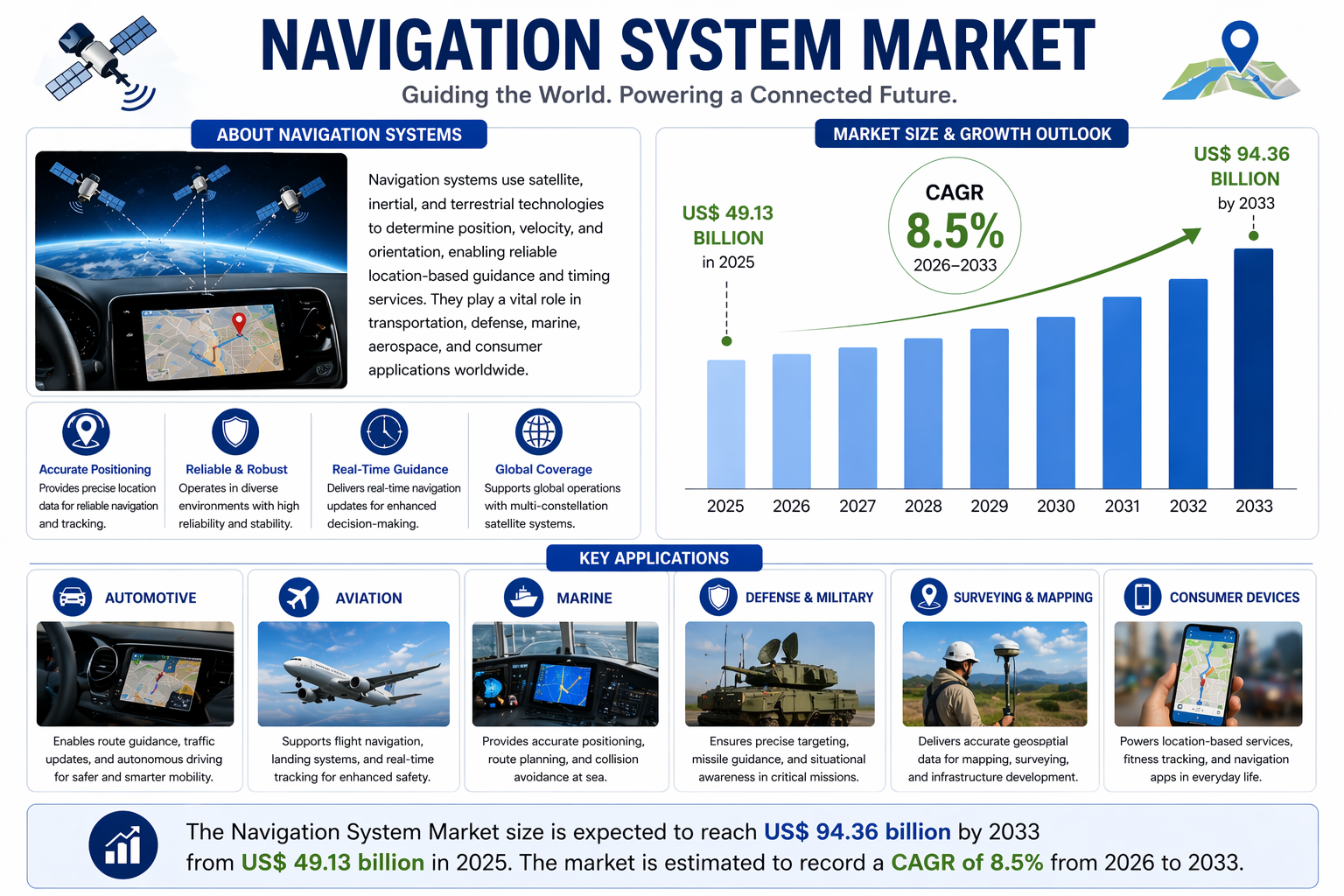
The Navigation System Market size is expected to reach US$ 94.36 billion by 2033 from US$ 49.13 billion in 2025. The market is estimated to record a CAGR of 8.5% from 2026 to 2033.
Navigation System Market Report Segmentation Analysis
The growth of this industry is best understood through a detailed Navigation System Market Report Segmentation Analysis. By breaking down the market into specific categories, we can identify the high growth pockets driving the 8.5% CAGR.
By Type: Satellite vs. Inertial vs. Radio
The market is primarily categorized into Satellite Navigation (GNSS), Inertial Navigation Systems (INS), and Radio Navigation. Global Navigation Satellite Systems (GNSS) currently dominate the market share due to the ubiquitous use of GPS, GLONASS, and Galileo in smartphones and vehicles. However, Inertial Navigation Systems are witnessing a surge in demand within the defense sector and for autonomous underwater vehicles (AUVs), where satellite signals may be obstructed or jammed.
By Application: Commercial and Defense
The application segment is broadly divided into commercial and military/defense. The commercial sector is fueled by the automotive industry’s shift toward Advanced Driver Assistance Systems (ADAS). On the other hand, the defense sector remains a steady contributor, investing heavily in high grade navigation for guided missiles, unmanned aerial vehicles (UAVs), and naval vessels to ensure operational superiority.
By End User Industry: Aerospace, Marine, and Automotive
The automotive segment remains the largest consumer of navigation technology, integrated into infotainment and telematics systems. The aerospace industry is the second largest segment, where precision is non negotiable for flight safety and air traffic management. The marine sector is also evolving, with electronic chart display and information systems (ECDIS) becoming standard for modern cargo and passenger ships.
Download Sample PDF Brochure: https://www.businessmarketinsights.com/sample/BMIPUB00032691
Market Dynamics and Regional Insights
Geographically, North America and Europe continue to be pioneers in navigation technology, home to major aerospace giants and tech innovators. However, the Asia Pacific region is projected to be the fastest growing market through 2033. This growth is attributed to massive investments in infrastructure, the rise of domestic smartphone manufacturing in China and India, and the expansion of regional satellite constellations like Beidou and NavIC.
Technological advancements such as Augmented Reality (AR) navigation are also gaining traction. AR overlays directional cues onto a real world view via windshields or smartphone cameras, significantly improving driver safety and urban navigation.
Competitive Landscape and Top Players
The global navigation system market is highly competitive, characterized by the presence of established aerospace and defense contractors alongside tech focused navigation providers. These companies are focusing on mergers, acquisitions, and R&D to maintain their market positions.
The top players in the market include:
-
Garmin Ltd.
-
Honeywell International Inc.
-
Collins Aerospace (RTX Corporation)
-
Northrop Grumman Corporation
-
The Boeing Company
-
Trimble Inc.
-
TomTom N.V.
-
Thales Group
-
Safran S.A.
-
Raytheon Technologies
These organizations are increasingly collaborating with software developers to integrate Artificial Intelligence (AI) into navigation algorithms, allowing for predictive traffic modeling and more efficient route optimization.
Future Outlook to 2033
Looking ahead, the market is poised for a decade of sustained growth. The transition from US$ 49.13 billion in 2025 to over US$ 94 billion by 2033 reflects a world that is becoming increasingly interconnected. The development of "Low Earth Orbit" (LEO) satellite constellations is expected to be a game changer, offering lower latency and stronger signals for navigation systems in remote areas. As autonomous "Level 5" driving moves closer to reality, the demand for redundant, ultra reliable navigation systems will only intensify.
About Business Market Insights
Business Market Insights is a market research platform that provides subscription services for industry reports, company profiles, and market trends. Our team of expert analysts constantly monitors various industry verticals to provide our clients with actionable insights and strategic growth roadmaps. We specialize in providing deep dive analysis across sectors such as Technology, Media, and Telecommunications (TMT), Aerospace & Defense, and Automotive.
Contact us:
Phone: +16464919876
Email: sales@businessmarketinsights.com
Sponsorizzato
Sponsorizzato
Categorie
Altri Articoli
Ciao a tutti. Sono Andrea ma potete chiamarmi Andi. Sono un appassionato di Musica, balli caraibici, Fumetti, Cinema. Mi piace promuovere eventi che possano creare aggregazione e stimolare la creatività. Nella mia attività principale svolgo la funzione di consulente mentre la domenica ed ogni volta che mi è possibile mi "trasformo" in addetto alle vendite di...

Recent insights indicate that the South Korea flat glass market is on a growth path that will see its size increase from 6.8 billion USD in 2024 to an anticipated 12 billion USD by 2035. This remarkable growth, translating to a CAGR of 5.3%, underscores the escalating demand for flat glass across various sectors. The market is driven by critical factors such as technological advancements,...
Aluminum extrusion has become an essential manufacturing process in the United States, supporting a wide range of industries with its versatility and efficiency. The ability to create complex shapes with precision has made aluminum extrusion a preferred choice for engineers and designers. As industries continue to innovate, the demand for high-quality aluminum components is steadily increasing....

The global infrastructure landscape is undergoing a massive transformation, driven by rapid urbanization, the digital revolution, and a worldwide shift toward renewable energy. At the heart of this transformation lies the wire and cable industry, providing the essential conduits for power transmission and data communication. As industries transition toward Industry 4.0 and governments invest...