


Carbon Black Market Analysis Report: Emerging Trends, Competitive Landscape & Growth Forecast
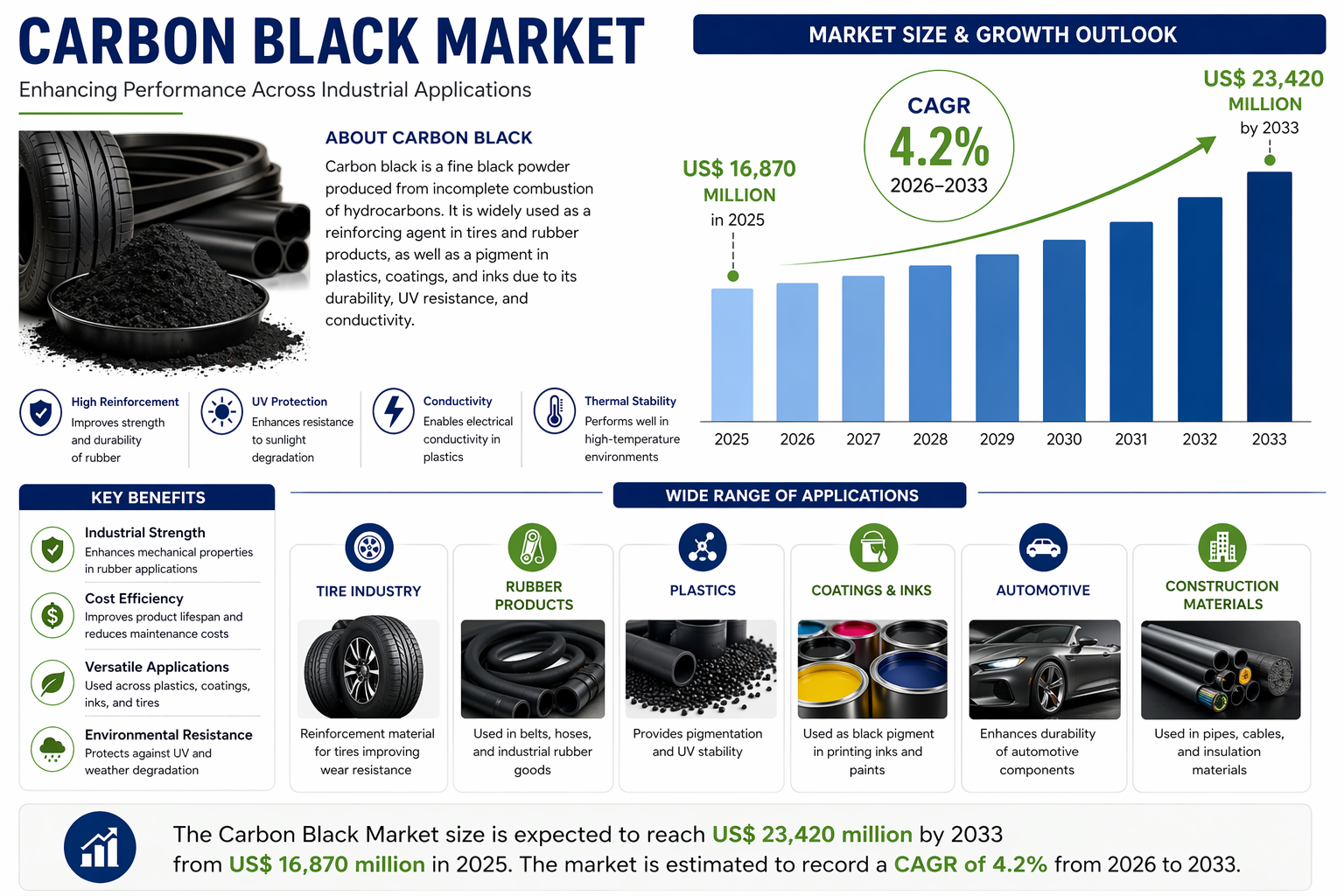
The global carbon black market is witnessing a significant transformation driven by the escalating demand from the tire manufacturing and industrial rubber sectors. Carbon black, a material produced by the incomplete combustion of heavy petroleum products, serves as a vital reinforcing filler that enhances the durability, conductivity, and tensile strength of rubber and plastic products. As global automotive production stabilizes and the shift toward electric vehicles (EVs) accelerates, the requirement for high-performance carbon black variants has never been higher.
Beyond the automotive industry, carbon black is increasingly utilized in the plastics, coatings, and inks industries. Its UV-stabilizing properties and pigmenting capabilities make it an essential component in packaging materials and high-end electronic housings. With advancements in manufacturing technologies and a growing emphasis on specialty grades, the market is poised for steady expansion through the next decade.
Download Sample PDF Report: https://www.businessmarketinsights.com/sample/BMIPUB00033808
Carbon Black Market Size and Growth Projections (2025–2033)
The financial trajectory of the industry reflects a resilient growth pattern. The Carbon Black Market size is expected to reach US$ 23,420 million by 2033 from US$ 16,870 million in 2025. The market is estimated to record a CAGR of 4.2% from 2026 to 2033. This growth is underpinned by the continuous expansion of the manufacturing sector in emerging economies and the rising replacement demand in the global tire industry.
The transition toward "Green Carbon Black" or recovered carbon black (rCB) from end-of-life tires is also expected to contribute to market valuation as sustainability regulations become more stringent across Europe and North America.
Carbon Black Market Share Analysis by Geography
In terms of regional distribution, the market exhibits a diverse landscape influenced by industrialization levels and raw material availability. Carbon Black Market Share Analysis by Geography reveals that the Asia-Pacific region currently dominates the global landscape, holding the largest market share. This dominance is attributed to the presence of massive automotive hubs in China, India, and Japan. China, in particular, remains the world's largest producer and consumer of carbon black, supported by a robust chemical manufacturing infrastructure and lower production costs.
North America follows as a significant contributor to the market. The regional growth is primarily fueled by the recovery of the US automotive sector and a high demand for specialty carbon black in the plastics and coatings industries. Furthermore, strict environmental regulations in the US and Canada are pushing manufacturers to adopt cleaner production technologies, leading to a higher market value for premium, low-emission grades.
In Europe, the market is characterized by a strong focus on sustainability and circular economy initiatives. The European market share is bolstered by the presence of leading tire manufacturers who are increasingly integrating recovered carbon black into their supply chains. Meanwhile, the Middle East and Africa, along with South America, are expected to witness moderate growth, driven by expanding construction activities and the domestic production of rubber based industrial goods.
Top Players in the Carbon Black Market
The competitive landscape is consolidated, with a few key players holding a significant portion of the global capacity. These companies focus on strategic mergers, capacity expansions, and R&D to maintain their market standing. Leading players include:
-
Cabot Corporation: A global leader in specialty chemicals and performance materials.
-
Birla Carbon (Aditya Birla Group): One of the largest manufacturers and suppliers of carbon black globally.
-
Orion Engineered Carbons: Known for its extensive portfolio of specialty and rubber carbon blacks.
-
PCBL Limited (Phillips Carbon Black Limited): A major player based in India with a growing global footprint.
-
Tokai Carbon Co., Ltd.: A key supplier focusing on high-quality carbon products for diverse industrial applications.
-
Mitsubishi Chemical Corporation: Providing advanced carbon materials for the electronics and automotive sectors.
Driving Factors and Industry Challenges
The primary driver for the market remains the tire industry, which accounts for over 70% of global carbon black consumption. The rise of electric vehicles is a specific catalyst; EVs are heavier than internal combustion engine vehicles, leading to faster tire wear and a greater need for high-reinforcement carbon black.
However, the industry faces challenges related to volatile raw material prices. Since carbon black is derived from crude oil derivatives like decant oil and coal tar, fluctuations in the energy market directly impact production costs. Additionally, environmental concerns regarding CO2 emissions during the "furnace black" process are forcing companies to invest heavily in carbon capture and emission control technologies.
Future Outlook: Specialty and Sustainable Grades
Looking toward 2033, the market is expected to pivot toward "specialty grades" used in conductive packaging and high-performance coatings. As the digital economy grows, the demand for conductive carbon black in lithium-ion batteries and electronic components will offer lucrative opportunities for manufacturers.
About Us
Business Market Insights is a market research platform that provides subscription services for industry reports, including in-depth analysis of technology, media, and chemicals sectors. We help businesses identify growth opportunities and navigate complex market dynamics with data-driven insights.
Contact us:
Phone: +1-646-491-9876
Email: sales@businessmarketinsights.com
Sponsorizzato
Sponsorizzato
Categorie
Altri Articoli
The global renal care industry is undergoing a period of intense innovation, with a heightened focus on the precision of treatment inputs. The Dialysis Concentrates and Solutions Market represents a critical component of this landscape, providing the essential chemical formulations required to maintain electrolyte balance and remove metabolic waste in patients with failing kidneys. As...

EI Transformer Factory is a commonly used term that refers to manufacturing environments focused on producing laminated core electrical devices designed to handle different voltage requirements. These products are widely applied in industrial systems, automation equipment, and power distribution networks where stable voltage management is essential. Different applications require specific...
